
About the Collection of Short Fiction
A History of endings & Other short stories
In A History of Endings & Other Short Stories, novelist Tom Maremaa gathers twenty-five works of literary fiction that move restlessly across continents, centuries, and states of mind—each story a meditation on the fragile moment when something irrevocable gives way to what comes next.
From a young Albert Einstein chafing against the machinery of education, to a historian uncovering impossible obituaries of Robert Johnson in a dust-choked archive, Maremaa’s characters inhabit the charged threshold between history and imagination, memory and myth. Presidents and poets, soldiers and scientists, forgotten children and failed prodigies all stand at their own private crossroads, confronting the quiet or catastrophic endings that shape their lives.
These stories unfold in blue-lit war rooms in Washington, D.C., fog-drenched apartments in Berkeley, archives in Copenhagen, riot-scarred hospital wards, andlabyrinthine streets from Bangalore to Santa Lucia. A blind photographer learns to see the texture of darkness. A mathematician-poet in Isfahan weighs equations against eternity. A journalist in 1964 records a conversation that may alter the trajectory of history. Across eras marked by war, exile, discovery, and loss, Maremaa’s narrators observe the world with lyrical precision and philosophical urgency.
Written in multiple points of view and unified by a distinctive, hypnotic prose style, this collection explores the geometry of faith, the archaeology of memory, and the invisible forces that govern human destiny. Each story stands alone; together, they form a mosaic of endings—personal, historical, and existential—revealing how every conclusion contains the seed of another beginning. Elegant, ambitious, and deeply human, A History of Endings & Other Short Stories is a sweeping literary collection for readers who are drawn to intellectually rich fiction, haunting atmospheres, and narratives that linger long after the final page. Here,
Maremaa invites us to witness the precise instant when lives fracture, histories pivot, and the ordinary world reveals its hidden metaphysical depths—one ending at a time.
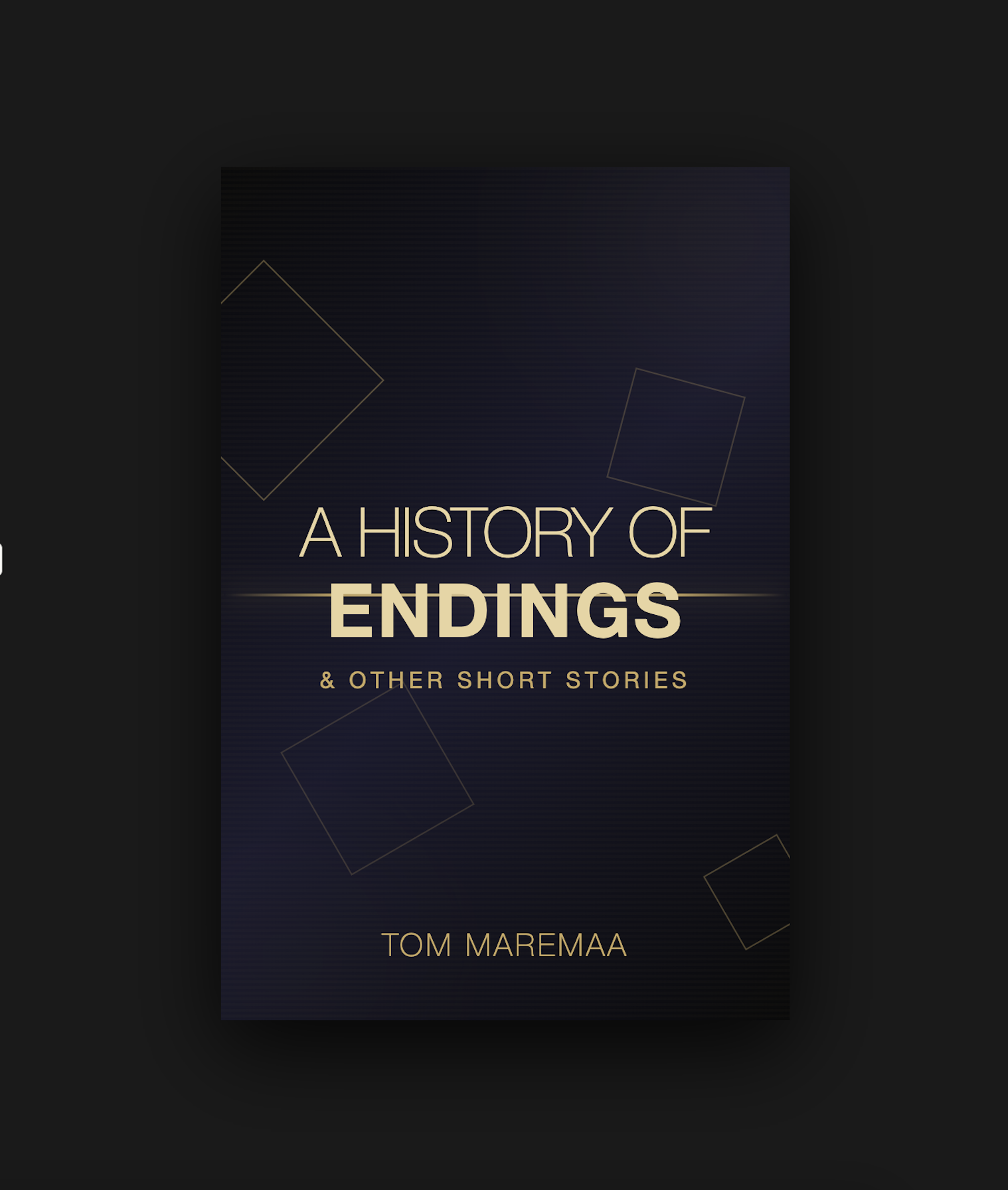
Book cover
Click this link for the book on Amazon & Apple Books:
Author’s. Notes
Short fiction is difficult to write because it demands precision, brevity, and narrative efficiency. Its masters are those who can evoke entire worlds and emotional truths in just a few pages. I think of Borges, Hemingway, Joyce, Raymond Carver and Flannery O’Connor, to name a few. While there are conventions and expectations, the form itself remains open and continually evolving. I’ve struggled with the form since I first began writing fiction as a young man: it looked easy but really was not.
Unlike novels, which allow for expansive character arcs and subplots, short stories demand that you establish character, conflict, and resolution in a compressed space. This often means showing character depth and change through minimal scenes or dialogue. I was told by my teachers to restrict the number of characters and keep the timeline brief to avoid clutter and maintain narrative focus. At some point I simply gave up and moved ahead to writing longer works, embracing the novel as my primary means of storytelling.
Now here I’ve returned and decided to challenge all the conventions I grew up learning, namely that every word counts, that you must focus on condensed character and plot development, be clever and limit your cast and timeframe, make sure there’s precision and control in every sentence, among other demands.
Probably, when I think about it, I’ve broken every rule and convention of the genre that I was taught. Maybe this happened at some unconscious level that I don’t really understand but nevertheless, it happened. I’ll try to explain some of my thinking. Bear with me.
For one thing, this collection presents a tapestry of interconnected stories that function as both individual narratives and components of a larger meditation on displacement, historical rupture, and the weight of unfulfilled potential. The opening paragraphs of each story establish a literary perspective deeply concerned with the moments when personal and historical trajectories intersect, often violently, reshaping the possibilities of human experience.
The stories operate within a framework of temporal fracture—each narrative is anchored to a specific historical moment that serves as both context and catalyst for personal transformation. From Einstein’s early antagonism toward institutional education to the unnamed advisors contemplating nuclear annihilation, from the journalist Ellison documenting what he intuits to be a crucial conversation in 1964 Miami Beach to young Akira Yamamoto processing Pearl Harbor’s aftermath, these opening passages suggest stories where individual consciousness collides with historical enormity.
All of the stories are broken into numbered sections that don’t follow linear time, jumping between perspectives and moments like archaeological fragments. Key events are approached obliquely, never fully explained but slowly revealed through accumulated details. The narrative voice in each story maintains a characteristic detachment while penetrating deeply into the characters’ inner lives and the larger historical forces that shape them.
Displacement and exile emerge as some of my central preoccupations. The collection features characters severed from their expected lives: Michael Malone returning from Iraq to permanent blindness, Rahul Kumar isolated from his successful brothers’ upward mobility. These are not merely stories of physical displacement but of ontological exile—characters forced to inhabit selves they never chose or anticipated.
Each opening establishes an omniscient narrator capable of both intimate psychological observation and sweeping historical perspective. The voice carries the weight of retrospective knowledge—“when the world had not yet learned to devour itself,” “when the world still made a kind of sense that would soon become impossible to recover”—suggesting that the stories are told from some future vantage point where the full consequences of these moments have been realized.
The opening passages also wrestle physically and emotionally with profound questions about agency, inheritance, and the relationship between individual will and historical necessity. The recurring motif of characters discovering unexpected documents, anomalies, or revelations (Robert Johnson’s multiple obituaries, the mysterious Copenhagen manuscript) is intended to describe how hidden or alternative histories continue to shape the present.
I use many elaborate, clause-heavy sentences to mirror the psychological complexity of characters caught between what they were and what they must become. The prose moves between the microscopic (the smell of tobacco and “something organic and faintly sweet”) and the telescopic (historical moments that “cleave time into before and after”).
The collection, from one point of view, is about what might be called the literature of historical witness. Rather than conventional historical fiction that explains the past, my stories appear more interested in exploring how historical events continue to reverberate through individual consciousness. It’s similar to Roberto Bolaño’s method of allowing historical trauma to seep into seemingly unrelated narratives, or Don DeLillo’s technique of finding the metaphysical implications of political moments.
In my view, contemporary short fiction can achieve novelistic scope through careful architectural planning. Each story can function as both standalone narrative and component of a larger structure examining American and global experiences of the twentieth century’s defining traumas.
A personal story of an unnamed protagonist can expand to encompass larger themes—environmental collapse, technological control, the commodification of memory itself. Another story circles around a central horror (the systematic harvesting of human consciousness, for example) that can never be fully articulated, only approached through indirection and metaphor.
What I am attempting to do is to make historical moments feel simultaneously inevitable and contingent, universal and intensely personal. For readers of literary short fiction, this represents writing that honors both the genre’s capacity for psychological precision and its potential for engaging with the largest questions of historical meaning and human consequence.